
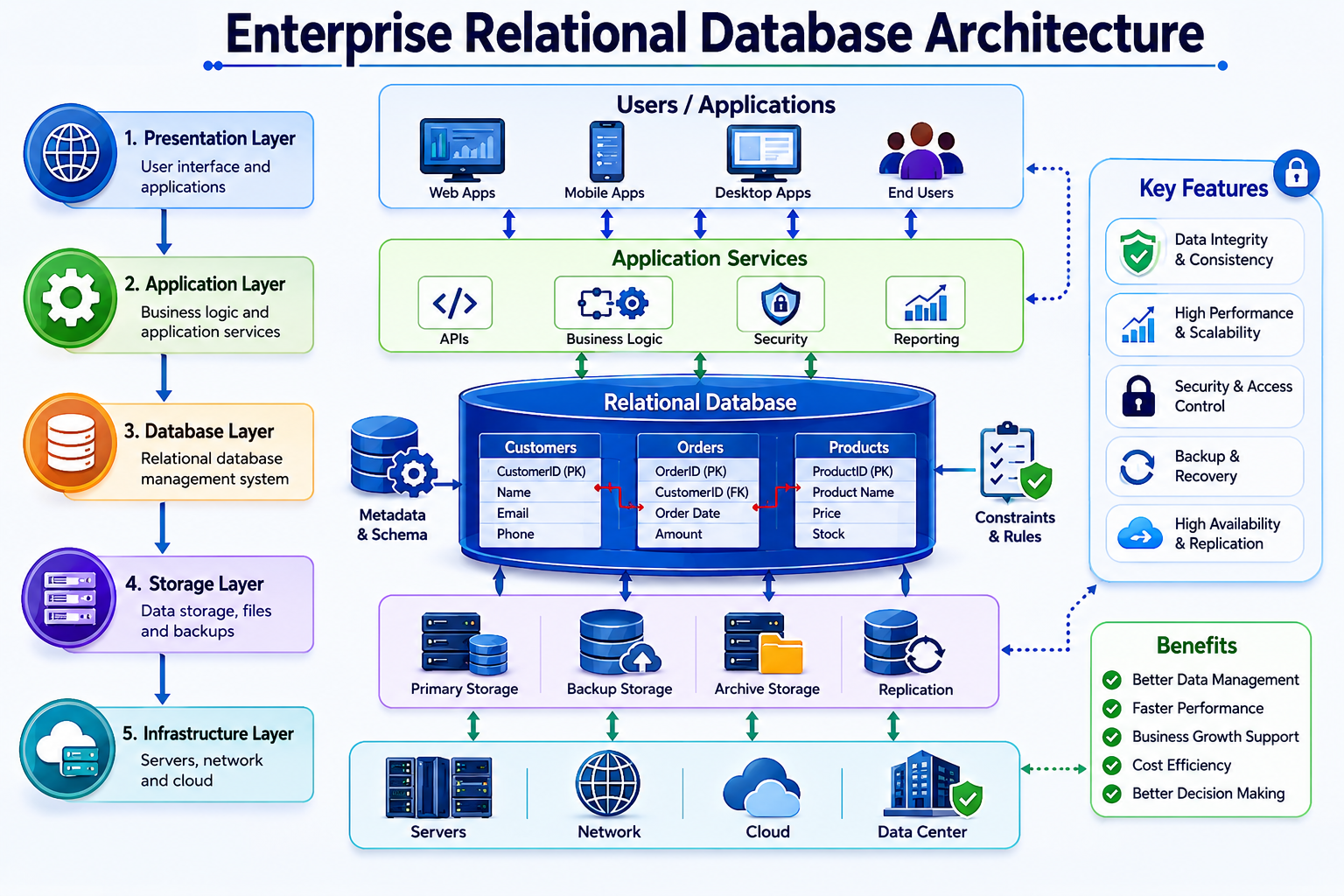
Enterprise Relational Database Architecture is the structure that helps organizations store, manage, and access data in a clear way. It uses tables, rows, and columns to keep information organized. Many companies use this architecture because it supports business operations, reporting, and data management.
Today, data drives almost every business process. Therefore, companies need a strong database design that supports growth and keeps information accurate. A relational database system connects related data through keys and relationships. As a result, teams can find and use data with ease.
Moreover, Enterprise Relational Database Architecture stands as one of the strongest and most reliable database frameworks for large organizations. It helps teams maintain data quality, improve performance, and support business goals.
Understanding Relational Databases
What Is a Relational Database
A relational database stores information in tables. Each table contains rows and columns. Rows hold records, while columns hold specific data fields. Therefore, users can organize information in a simple structure.
For example, a customer table may contain names, phone numbers, and email addresses. Another table may contain order details. A relationship connects these tables through a common key. Thus, users can access connected information without confusion.
Core Components of a Relational Database
Several components work together in a relational database. Tables store information. Keys create relationships. Queries retrieve data. Indexes improve search speed. Therefore, the system performs tasks with efficiency.
Furthermore, constraints help maintain data accuracy. Database schemas define the structure. As a result, organizations can manage large amounts of information without losing consistency.
Key Layers of Enterprise Database Architecture
Data Storage Layer
The data storage layer keeps records in physical storage systems. It manages how data enters and leaves the database. Therefore, it forms the foundation of the architecture.
Moreover, storage systems support backups and recovery processes. This layer helps organizations protect valuable business information. As a result, data remains available when teams need it.
Database Management Layer
This layer controls database operations. It manages transactions, permissions, and queries. Therefore, users can interact with data safely.
In addition, the management layer checks data integrity rules. It helps prevent errors and supports reliable operations. Thus, businesses maintain trust in their information.
Application Layer
Applications connect users to the database. Employees use software tools to create, update, and view records. Therefore, this layer supports daily business activities.
Likewise, business applications communicate with databases through APIs and database drivers. As a result, information moves between systems without issues.
Database Design Principles
Data Normalization
Normalization organizes data into separate tables. This process removes duplicate information. Therefore, databases remain clean and efficient.
Moreover, normalization improves data consistency. When users update information, changes occur in one location. Thus, organizations reduce data errors.
Entity Relationships
Entities represent business objects such as customers, products, and orders. Relationships connect these entities. Therefore, users can understand how information links together.
For instance, one customer may have many orders. This relationship creates a clear structure. As a result, database queries become easier to manage.
Types of Database Keys
Primary Key
A primary key identifies each record in a table. Every value remains unique. Therefore, users can locate records without confusion.
Furthermore, primary keys support relationships between tables. They help maintain data accuracy throughout the database structure.
Foreign Key
A foreign key links one table to another. Therefore, related data remains connected across the database.
For example, an order table may contain a customer ID. That ID connects to the customer table. Thus, users can view complete business information.
Database Performance Optimization
Indexing Strategy
Indexes improve data retrieval speed. They work like a book index. Therefore, the database finds information faster.
However, too many indexes can increase storage use. Therefore, database teams choose indexes with care. As a result, systems maintain strong performance.
Query Optimization
Query optimization improves database efficiency. Developers write clean SQL statements. Therefore, the system processes requests faster.
Additionally, optimized queries reduce server workload. Thus, organizations improve user experience and resource usage.
Security in Enterprise Databases
Access Control
Access control limits database permissions. Users receive access based on their roles. Therefore, sensitive information stays protected.
Moreover, administrators monitor user activity. As a result, organizations reduce security risks and support compliance requirements.
Data Encryption
Encryption protects information during storage and transfer. Therefore, unauthorized users cannot read sensitive data.
Likewise, encryption supports privacy regulations and industry standards. Thus, businesses strengthen their security framework.
High Availability and Disaster Recovery
Database Replication
Replication creates copies of data across multiple servers. Therefore, organizations reduce downtime risks.
Additionally, replicated systems improve availability during hardware failures. As a result, business operations continue without major interruptions.
Backup and Recovery
Backup systems create copies of important data. Therefore, organizations can recover information after unexpected events.
Furthermore, recovery plans support business continuity. Thus, companies protect critical assets and maintain operations.
Enterprise Database Architecture Components
| Component | Purpose | Benefit |
| Tables | Store data | Organized records |
| Indexes | Speed searches | Better performance |
| Keys | Connect tables | Data integrity |
| Queries | Retrieve data | Fast access |
| Views | Simplify access | Better usability |
Common Database Design Elements
| Element | Function | Example |
| Entity | Business object | Customer |
| Attribute | Data field | |
| Relationship | Connection | Customer to Order |
| Schema | Structure definition | Database model |
| Constraint | Data rule | Unique ID |
Benefits of Enterprise Relational Database Architecture
Improved Data Integrity
Data integrity ensures accurate information. Therefore, organizations trust their reports and decisions.
Moreover, validation rules reduce mistakes. As a result, databases maintain consistent records across departments.
Better Scalability
Scalability supports business growth. Organizations can add storage, users, and applications over time. Therefore, the architecture adapts to changing needs.
Likewise, scalable systems support future expansion. Thus, businesses avoid costly redesign projects.
Strong Business Intelligence Support
Business intelligence tools depend on reliable data. Therefore, relational databases provide a solid foundation for analytics.
Furthermore, structured data improves reporting accuracy. As a result, leaders make informed decisions based on trusted information.
Best Practices for Enterprise Database Management
Create a Clear Data Model
A clear data model improves organization. Therefore, developers understand relationships and structures from the start.
Monitor Database Performance
Performance monitoring helps teams detect issues early. Therefore, organizations maintain smooth operations and user satisfaction.
Maintain Regular Backups
Regular backups protect critical information. Therefore, businesses recover quickly after unexpected events.
FAQ’s
What is Enterprise Relational Database Architecture?
It is a structured framework that stores and manages business data through related tables, keys, and relationships. It supports large-scale operations and data management.
Why do enterprises use relational databases?
Organizations use relational databases because they provide data integrity, security, scalability, and strong reporting capabilities.
What is the role of a primary key?
A primary key uniquely identifies each record in a table. It helps users locate information and maintain data consistency.
How does normalization improve databases?
Normalization removes duplicate data and improves organization. Therefore, it increases efficiency and reduces errors.
Why is database security important?
Database security protects sensitive information from unauthorized access. It also supports compliance and business trust.
Conclusion
Enterprise Relational Database Architecture provides a strong foundation for modern organizations. It organizes information through tables, relationships, and structured data models. Therefore, businesses can manage large datasets with confidence.
Moreover, this architecture supports performance, security, and scalability. Features such as indexing, replication, and normalization help organizations maintain efficient operations. As a result, teams gain reliable access to important information.
Finally, companies that invest in strong database architecture improve decision-making and data quality. Therefore, they build a dependable environment that supports long-term business growth and success.