
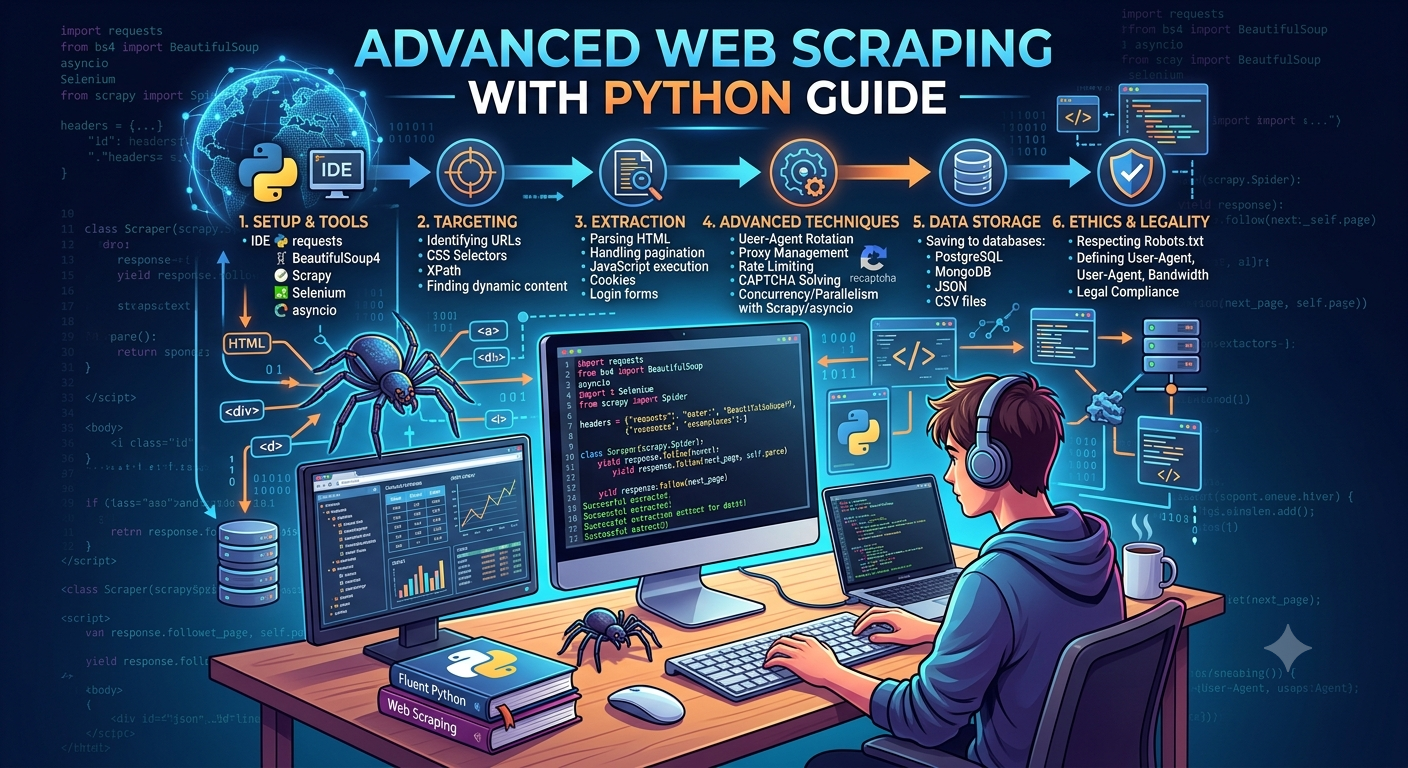
Web scraping is a method that collects information from websites through code. Python gives developers simple tools for this task. Many businesses use web scraping for research, price tracking, and content analysis. The process saves time because a program gathers data instead of manual work.
Advanced Web Scraping with Python stands as one of the most powerful methods for large-scale data extraction. It helps users collect data from many pages with speed and accuracy. Moreover, Python offers strong libraries that make scraping easier for beginners and experts.
Understanding How Web Scraping Works
Web scraping starts when a program sends a request to a website. The server returns a response that contains page content. Then the scraper reads the content and extracts useful information.
Next, the scraper finds specific elements such as headings, prices, links, or product details. After that, it stores the information in files or databases. As a result, users gain structured data for analysis and reporting.
Request and Response Cycle
A scraper sends an HTTP request to a target website. The server receives the request and returns page data. Then Python processes the returned content. This cycle forms the foundation of every scraping project. Therefore, understanding requests and responses helps developers build stable scraping systems.
HTML Structure Basics
Most websites use HTML to organize content. Tags define headings, paragraphs, tables, and links. A scraper reads these tags and identifies needed data. When developers understand HTML structure, they can locate elements with precision. Consequently, data extraction becomes more accurate and reliable.
Benefits of Advanced Web Scraping
Advanced scraping provides access to large amounts of information. Businesses use it to monitor competitors, track trends, and collect market intelligence. Craping supports decision-making. Companies analyze collected information and discover valuable insights. As a result, teams improve planning and strategy.
Data Collection at Scale
Large websites contain thousands of pages. Manual collection takes a lot of effort. However, automated scraping gathers information within minutes. Organizations can build large datasets for research, machine learning, and business analysis.
Market Research Support
Companies track prices, reviews, and product details across multiple platforms. This information helps them understand customer behavior. Collected data reveals market trends. Thus, businesses make informed decisions based on real information.
Essential Python Libraries
Python offers many libraries for web scraping. Each library serves a specific purpose. Therefore, developers choose tools according to project needs.
| Library | Main Purpose | Best Use Case |
| Requests | Send HTTP requests | Static websites |
| Beautiful Soup | Parse HTML | Data extraction |
| Scrapy | Full scraping framework | Large projects |
| Selenium | Browser automation | Dynamic websites |
Requests
Requests sends HTTP requests with simple syntax. It retrieves web pages quickly and efficiently. Because of its simplicity, many developers start scraping projects with Requests.
Beautiful Soup
Beautiful Soup parses HTML and XML documents. It helps locate tags, classes, and attributes. Therefore, developers can extract targeted information with ease.
Scrapy
Scrapy is a complete scraping framework. It supports crawling, data extraction, and storage. Large projects benefit from Scrapy because it handles many pages efficiently.
Selenium
Some websites load content through JavaScript. Selenium controls a real browser and accesses dynamic content. Thus, developers can collect information from modern web applications.
Setting Up a Python Scraping Environment
A good environment improves project stability. First, install Python on your system. Next, create a virtual environment for dependency management. Then install required libraries through package managers. This approach keeps projects organized. Moreover, it reduces conflicts between different tools and versions.
Steps for Building a Scraper
Creating a scraper follows a structured workflow. Each step contributes to successful data extraction.
Step 1: Send Requests
First, connect to the target website. Then retrieve the page source. A successful request provides access to the content needed for extraction.
Step 2: Parse Data
Next, analyze the page structure. Find the required tags and elements. Then extract the data and organize it into structured formats.
Step 3: Store Results
After extraction, save the information. Common formats include CSV, JSON, and databases. As a result, users can access and analyze data later.
Handling Dynamic Websites
Many websites use JavaScript to display content. Traditional scraping methods may not capture this information.
Therefore, tools such as Selenium help load pages completely. Once the content appears, the scraper extracts the required data. This method improves access to dynamic elements and user-generated content.
Working with APIs
Some websites provide APIs for data access. APIs deliver structured information in formats like JSON. Using APIs often improves reliability. Moreover, APIs reduce parsing complexity because the data arrives in an organized format.
Data Cleaning and Processing
Raw data often contains duplicates and formatting issues. Therefore, cleaning becomes an important step. Developers remove unwanted characters, fix missing values, and standardize formats. As a result, the dataset becomes accurate and ready for analysis.
| Data Issue | Solution |
| Duplicate records | Remove repeated entries |
| Missing values | Replace or remove |
| Formatting errors | Standardize formats |
| Extra spaces | Trim whitespace |
Avoiding Common Challenges
Web scraping projects face several obstacles. Websites may change layouts, block requests, or limit access. Developers should create flexible code. Regular updates help maintain scraper performance. In addition, proper error handling improves reliability and reduces failures.
Performance Optimization Techniques
Fast scrapers save time and resources. Therefore, optimization plays a key role in advanced projects. Developers use connection pooling, asynchronous requests, and efficient parsing methods. These techniques improve speed while reducing server load. Consequently, large-scale scraping becomes more practical.
Security and Ethical Considerations
Responsible scraping protects both users and websites. Developers should review website terms and access policies before collecting information. Limiting request frequency reduces strain on servers. Ethical practices support sustainable data collection and maintain positive relationships between organizations and website owners.
Best Practices for Advanced Web Scraping
Successful projects follow proven methods. Clean code improves maintenance and readability. Developers should use structured logging, error handling, and data validation. Furthermore, regular testing helps identify issues before they affect production systems. As a result, projects remain stable and dependable.
FAQ’s
What is advanced web scraping?
Advanced web scraping refers to collecting data from complex websites through specialized techniques. It often involves automation, browser control, and large-scale data extraction.
Why is Python popular for web scraping?
Python offers simple syntax and powerful libraries. Therefore, developers can build scraping solutions with less effort and strong flexibility.
When should Selenium be used?
Selenium works best with websites that load content through JavaScript. It allows interaction with dynamic elements and browser actions.
Is API data better than web scraping?
APIs often provide structured information. Therefore, they reduce parsing work and improve reliability when available.
How can scraping performance improve?
Developers improve performance through asynchronous requests, efficient parsing, caching, and optimized storage methods.
Conclusion
Advanced web scraping helps organizations collect valuable information from the internet. Python provides powerful tools that support efficient extraction, processing, and storage of data. Therefore, developers use Python for projects of all sizes.
Moreover, modern scraping techniques handle dynamic websites, APIs, and large datasets. These capabilities allow businesses to gather insights that support research and planning. As a result, data-driven decisions become easier and more accurate.
Finally, successful scraping projects follow ethical standards, optimization methods, and best practices. When developers build reliable systems, they create high-quality datasets that support analytics, machine learning, and business growth.