
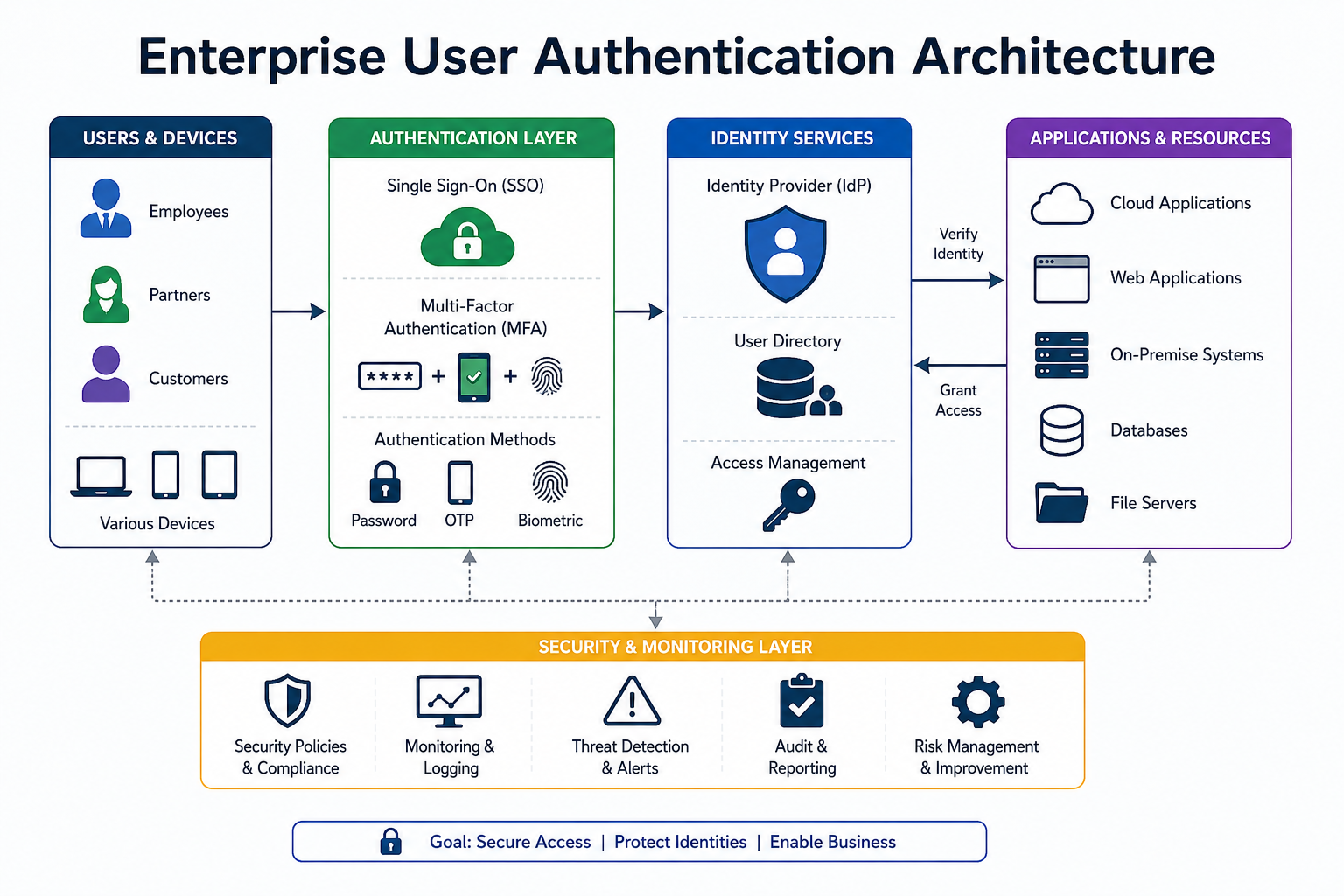
Enterprise User Authentication Architecture is the system that checks and confirms user identity before access to company apps, data, and services. It helps organizations protect accounts and keep business resources safe. Today, companies use many cloud platforms, mobile apps, and internal systems. Because of this, a strong authentication structure plays a key role in cybersecurity.
The best Enterprise User Authentication Architecture creates secure access while keeping the login process simple. It supports identity management, access control, user verification, and security policies. As a result, businesses reduce risks and improve user trust.
Understanding Enterprise User Authentication Architecture
Enterprise authentication architecture defines how users prove their identity across business systems. It includes login methods, security controls, and identity verification processes. These components work together to protect sensitive information.
Moreover, organizations use authentication frameworks to manage thousands of users. Employees, contractors, and customers access resources through secure login systems. Therefore, a unified architecture improves security and efficiency.
Core Purpose of Authentication
Authentication confirms that a user is who they claim to be. It acts as the first security layer before authorization takes place.
Furthermore, strong authentication protects digital assets from unauthorized access. Companies depend on this protection to maintain business continuity and data security.
Key Components of Authentication Architecture
Several components create a complete authentication environment. Each part supports security and user management goals. These components include identity providers, authentication servers, credential storage, access management systems, and monitoring tools. Together, they form a secure authentication ecosystem.
H3: Main Components Table
| Component | Purpose |
| Identity Provider | Verifies user identity |
| Authentication Server | Processes login requests |
| Directory Service | Stores user information |
| Access Management | Controls permissions |
| Security Monitoring | Detects threats |
Identity Management Foundation
Identity management forms the base of authentication architecture. It stores user profiles, credentials, and access information in a central location. As organizations grow, identity management keeps user records organized. Consequently, administrators manage access rights with greater accuracy and control.
User Lifecycle Management
User lifecycle management handles account creation, updates, and removal. This process ensures that users receive proper access during their employment period. Likewise, organizations remove access when users leave. This step reduces security risks and protects sensitive systems.
Single Sign-On Integration
Single Sign-On, or SSO, allows users to access multiple applications with one login. This approach improves convenience and reduces password fatigue. SSO decreases password reset requests. As a result, IT teams save time while users enjoy a smoother experience.
Benefits of SSO
Organizations use SSO to simplify authentication. Users log in once and gain access to approved systems. Therefore, companies improve productivity and strengthen security policies across applications.
Multi-Factor Authentication Protection
Multi-Factor Authentication, known as MFA, requires more than one verification method. Users may enter a password and confirm identity through a mobile device. Because of this extra layer, attackers face greater difficulty when attempting unauthorized access. Trust me, MFA remains one of the strongest security controls in modern environments.
Common MFA Factors
| Authentication Factor | Example |
| Knowledge Factor | Password |
| Possession Factor | Mobile Device |
| Inherence Factor | Fingerprint |
| Location Factor | Trusted Network |
Password Management Strategy
Passwords remain part of many authentication systems. However, organizations must enforce strong password policies. For example, companies require complex passwords, expiration schedules, and secure storage methods. Consequently, password-based attacks become less effective.
Role-Based Access Control
Role-Based Access Control, or RBAC, grants permissions based on job roles. Employees receive access according to responsibilities rather than individual assignments. As a result, administrators manage permissions more efficiently. Look, this approach also reduces human error during access management.
RBAC Advantages
RBAC improves consistency across departments. Similar job roles receive similar permissions. Furthermore, audits become easier because access rules follow clear organizational structures.
Federated Identity Systems
Federated identity enables users to authenticate across multiple organizations using trusted identity providers. This model supports partnerships and cloud services. Businesses reduce credential duplication. Therefore, users enjoy secure access across connected environments.
Authentication Protocols
Authentication protocols define communication standards between systems. These standards ensure secure identity verification.
Popular protocols include SAML, OAuth 2.0, OpenID Connect, and Kerberos. Each protocol serves different authentication needs.
Popular Protocol Comparison
| Protocol | Primary Use |
| SAML | Enterprise SSO |
| OAuth 2.0 | API Access |
| OpenID Connect | User Authentication |
| Kerberos | Internal Networks |
Zero Trust Authentication Model
Zero Trust follows the principle of continuous verification. No user receives automatic trust based on location or network connection. Instead, systems verify identity during every access request. Consequently, organizations strengthen defense against modern cyber threats.
Cloud Authentication Architecture
Many enterprises operate in cloud environments. Therefore, authentication systems must support cloud applications and services. Cloud authentication integrates identity providers, access management tools, and security controls. This structure helps organizations manage users across distributed environments.
Security Monitoring and Logging
Authentication monitoring tracks login activities and security events. Organizations use logs to identify suspicious behavior. For instance, repeated failed login attempts may indicate an attack. Therefore, monitoring tools help security teams respond quickly.
Monitoring Functions
Security teams analyze authentication logs to detect risks. They also review access patterns and user behavior. As a result, businesses improve threat detection and incident response capabilities.
Compliance and Regulatory Support
Many industries follow security regulations. Authentication architecture supports compliance requirements through access controls and audit records. Furthermore, organizations demonstrate accountability through documented authentication processes. This practice supports governance and risk management goals.
Scalability in Enterprise Environments
Large organizations manage thousands of users across multiple locations. Authentication architecture must support this growth. Scalable solutions handle increased login requests and user records without performance issues. Bro, scalability remains important for long-term business success.
Authentication Architecture Best Practices
Strong authentication requires planning and continuous improvement. Organizations should implement security standards and review policies regularly. Key practices include MFA deployment, centralized identity management, access reviews, monitoring, and user training. These measures strengthen overall security posture.
Implementation Steps
Step 1: Define Identity Requirements
Identify users, systems, and access needs across the organization.
Step 2: Select Authentication Methods
Choose suitable authentication technologies and security controls.
Step 3: Deploy Access Management
Implement centralized identity and access management solutions.
Step 4: Enable Monitoring
Track authentication events and security alerts.
Step 5: Review and Improve
Conduct regular audits and update security policies.
Future Trends in Enterprise Authentication
Authentication continues to evolve with technology. Passwordless authentication gains attention because it reduces credential risks. Likewise, biometric verification, AI-driven security analysis, and adaptive authentication continue to grow. These innovations support stronger protection and improved user experiences.
FAQ’s
What is Enterprise User Authentication Architecture?
It is a framework that verifies user identities before granting access to enterprise systems, applications, and data.
Why is Multi-Factor Authentication important?
MFA adds extra security layers and reduces the risk of unauthorized account access.
What is Single Sign-On?
Single Sign-On allows users to access multiple applications through one login session.
How does Role-Based Access Control work?
RBAC assigns permissions according to job roles, which simplifies access management.
What are common authentication protocols?
Common protocols include SAML, OAuth 2.0, OpenID Connect, and Kerberos.
Conclusion
Enterprise User Authentication Architecture serves as the foundation of modern identity security. It protects users, applications, and business resources through structured authentication processes. Organizations depend on these systems to maintain secure access across digital environments.
Moreover, technologies such as Single Sign-On, Multi-Factor Authentication, and Role-Based Access Control strengthen security while improving user experience. Together, these tools create a balanced approach between protection and productivity.
As businesses continue digital transformation, authentication architecture remains a critical investment. Companies that implement strong identity management, continuous monitoring, and modern authentication methods build a safer and more resilient security framework.