
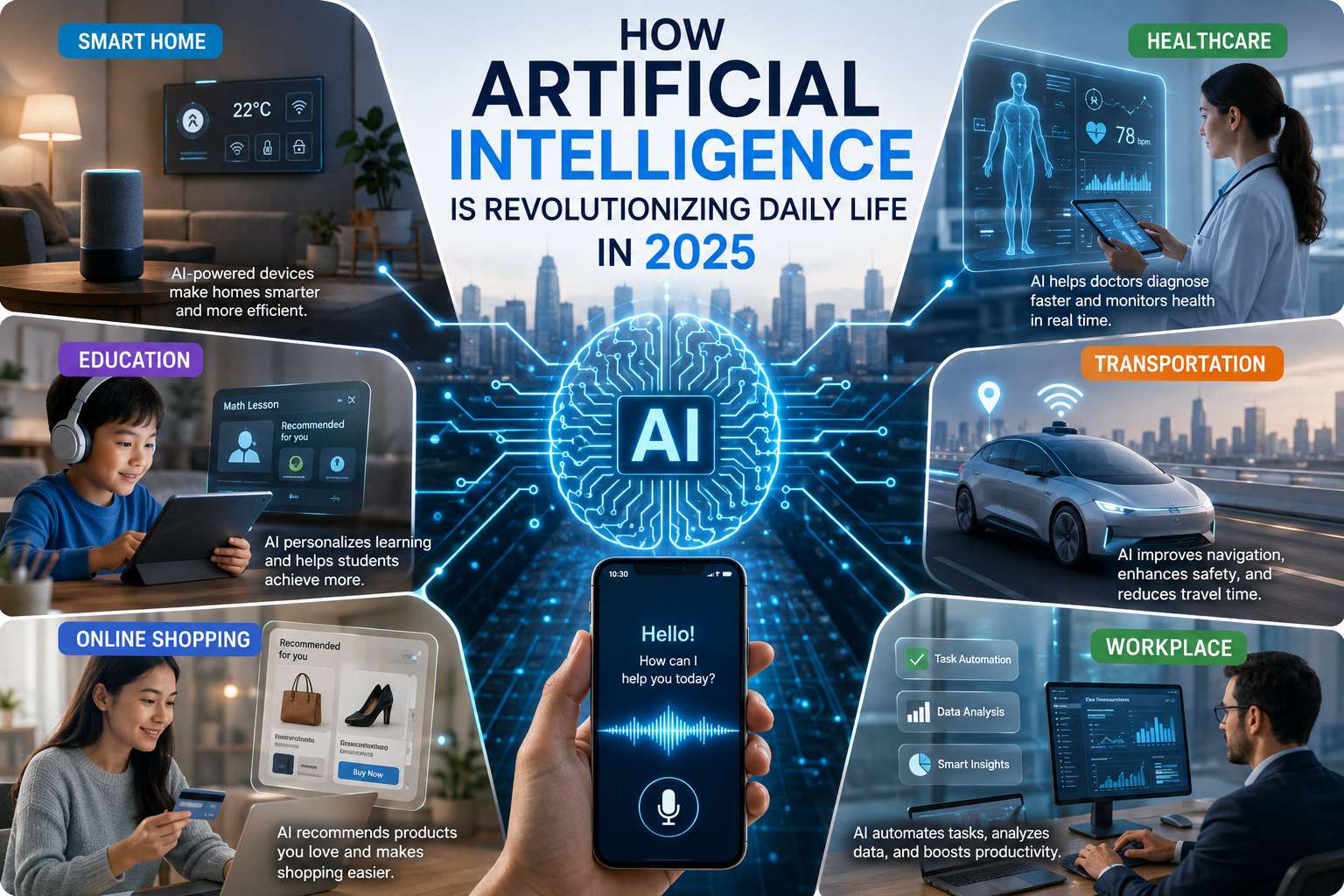
Artificial Intelligence (AI) is one of the biggest technologies in 2025. It helps people work, learn, shop, travel, and stay healthy. Today, AI is part of daily life. It works in phones, computers, cars, and smart home devices. As a result, many tasks take less time and effort.
People use AI without thinking about it. For example, voice assistants answer questions, while navigation apps find fast routes. AI also helps businesses serve customers better. Because of this, many industries now depend on AI tools.
Look, AI keeps growing every year. It changes how people live and work. The topic How Artificial Intelligence Is Revolutionizing Daily Life in 2025 shows one of the most important technology changes in modern history. Trust me, AI now touches almost every part of life.
Understanding Artificial Intelligence
What AI Means
Artificial Intelligence is technology that allows machines to learn and make decisions. It uses data to understand patterns and solve problems. Because of this, computers can perform tasks that once needed human thinking.
AI systems process large amounts of information quickly. Then they provide useful answers or actions. As a result, people save time and improve productivity.
Main Types of AI in Daily Life
Most people use AI every day through common applications. These tools work in the background and improve user experiences. For example, recommendation systems suggest movies, songs, and products.
AI also powers virtual assistants, language tools, and smart devices. Therefore, daily tasks become easier and more convenient.
| AI Type | Common Use |
| Machine Learning | Predictions and recommendations |
| Natural Language Processing | Chatbots and voice assistants |
| Computer Vision | Face recognition and image analysis |
| Robotics | Automated physical tasks |
AI in Smart Homes
Smarter Home Devices
Smart homes use AI to control lights, security systems, and appliances. These devices learn user habits over time. As a result, they improve comfort and reduce energy use.
For example, smart thermostats adjust temperatures automatically. Likewise, smart cameras detect unusual activity and send alerts.
Better Energy Management
AI helps families lower electricity bills. It tracks energy consumption and suggests efficient settings. Therefore, homes use less power while maintaining comfort.
You know, many smart systems now work together. Because of this, homeowners enjoy more control through a single app.
AI in Healthcare
Faster Health Monitoring
Healthcare has changed with AI technology. Smart watches and fitness trackers monitor heart rates, sleep patterns, and activity levels. As a result, people gain better insights into their health.
Doctors also use AI tools to review medical data. Therefore, they can identify concerns earlier and provide timely care.
Improved Medical Support
AI helps healthcare professionals analyze large amounts of information. It supports diagnosis and treatment planning. Because of this, healthcare services become more efficient.
| AI Healthcare Tool | Benefit |
| Health Trackers | Daily monitoring |
| Diagnostic Systems | Faster analysis |
| Medical Chatbots | Basic health guidance |
| Remote Monitoring | Better patient support |
AI in Education
Personalized Learning
AI helps students learn at their own pace. Educational platforms adapt lessons based on performance. As a result, students receive support where they need it most.
Teachers also use AI tools to track progress. Therefore, they can focus on helping students improve specific skills.
Better Access to Knowledge
AI-powered learning apps provide information quickly. Students can access lessons, summaries, and practice exercises anytime. Because of this, learning becomes more flexible.
Like, many language-learning apps now use AI to improve speaking and reading skills. This creates a better learning experience.
AI in Transportation
Smarter Navigation
AI improves navigation systems by analyzing traffic conditions. It recommends efficient routes and reduces travel time. As a result, drivers reach destinations faster.
Navigation apps also update routes in real time. Therefore, users avoid traffic delays and road closures.
Safer Driving Experience
Modern vehicles use AI-powered safety features. These systems monitor surroundings and assist drivers during travel. Because of this, roads become safer for everyone.
Bro, many new vehicles now include intelligent parking assistance and collision warnings. These features support safer transportation.
AI in Online Shopping
Personalized Recommendations
Online stores use AI to understand customer preferences. Then they recommend products based on interests and buying habits. As a result, shopping becomes faster and easier.
Customers spend less time searching for products. Therefore, they enjoy a smoother shopping experience.
Better Customer Service
AI chatbots provide support throughout the day. They answer questions and guide customers through purchases. Because of this, businesses improve customer satisfaction.
You know, many shoppers now receive instant help without waiting for human support.
AI in the Workplace
Increased Productivity
Businesses use AI to automate repetitive tasks. Employees then focus on creative and strategic work. As a result, productivity improves across many industries.
AI tools also organize schedules, manage data, and generate reports. Therefore, workers complete tasks more efficiently.
Smarter Business Decisions
Companies analyze data with AI systems. These tools identify trends and patterns quickly. Because of this, business leaders make informed decisions.
Trust me, organizations that use AI often gain valuable insights faster than traditional methods.
AI in Entertainment
Better Content Suggestions
Streaming services use AI to recommend movies, music, and shows. These recommendations match user interests. As a result, people find content they enjoy more easily.
AI learns from viewing habits over time. Therefore, recommendations continue improving.
Interactive Experiences
Video games use AI to create realistic characters and environments. Because of this, players enjoy more engaging experiences.
Likewise, AI tools help creators produce digital content faster and more efficiently.
AI and Personal Finance
Smarter Money Management
AI-powered financial apps help users track spending and savings. They analyze habits and provide useful suggestions. As a result, people manage money more effectively.
Many apps also send alerts about unusual transactions. Therefore, users gain additional financial security.
Fraud Detection
Banks use AI to identify suspicious activities. These systems detect unusual patterns quickly. Because of this, financial institutions reduce fraud risks.
AI continues to strengthen digital payment systems and online banking services.
Challenges of AI in 2025
Privacy Concerns
As AI collects more data, privacy becomes important. Organizations must protect user information and follow security standards. Therefore, responsible data management remains essential.
Users should also understand how companies use their information. Because of this, transparency matters.
Need for Human Oversight
AI supports decision-making, but people still play a key role. Human judgment helps ensure fairness and accuracy. As a result, AI and humans work best together.
Many experts support balanced AI development that combines innovation with responsibility.
Future of AI Beyond 2025
Continued Innovation
AI technology continues to advance. New tools will improve healthcare, education, transportation, and business operations. Therefore, daily life will become even more connected and efficient.
Researchers also explore new ways to improve AI performance. Because of this, future applications may offer greater benefits.
Greater Human-AI Collaboration
The future will likely focus on collaboration between people and intelligent systems. AI will support human abilities rather than replace them. As a result, individuals can achieve more with technology.
Look, this partnership may shape the next generation of innovation and growth.
FAQ’s
What is Artificial Intelligence?
Artificial Intelligence is technology that allows machines to learn, analyze information, and perform tasks that normally require human thinking.
How does AI help in daily life?
AI helps with navigation, online shopping, education, healthcare, smart homes, and many other everyday activities.
Is AI safe to use?
AI is generally safe when companies follow strong security and privacy practices. Responsible use remains important.
Which industries use AI the most?
Healthcare, education, transportation, finance, retail, and entertainment are among the largest users of AI technology.
Will AI replace human jobs completely?
AI automates some tasks, but many jobs still need human creativity, judgment, and problem-solving skills.
Conclusion
Artificial Intelligence has become an important part of daily life in 2025. It supports people at home, at work, and during travel. As a result, many tasks become faster and easier. AI also helps businesses improve services and efficiency.
Healthcare, education, finance, and transportation continue to benefit from AI solutions. Therefore, people experience better convenience, safety, and productivity. At the same time, privacy and responsible use remain important topics for society.
The future of AI looks promising. New innovations will continue to improve daily experiences and create opportunities across industries. Because of this, AI will remain a major force shaping the modern world for years to come.