
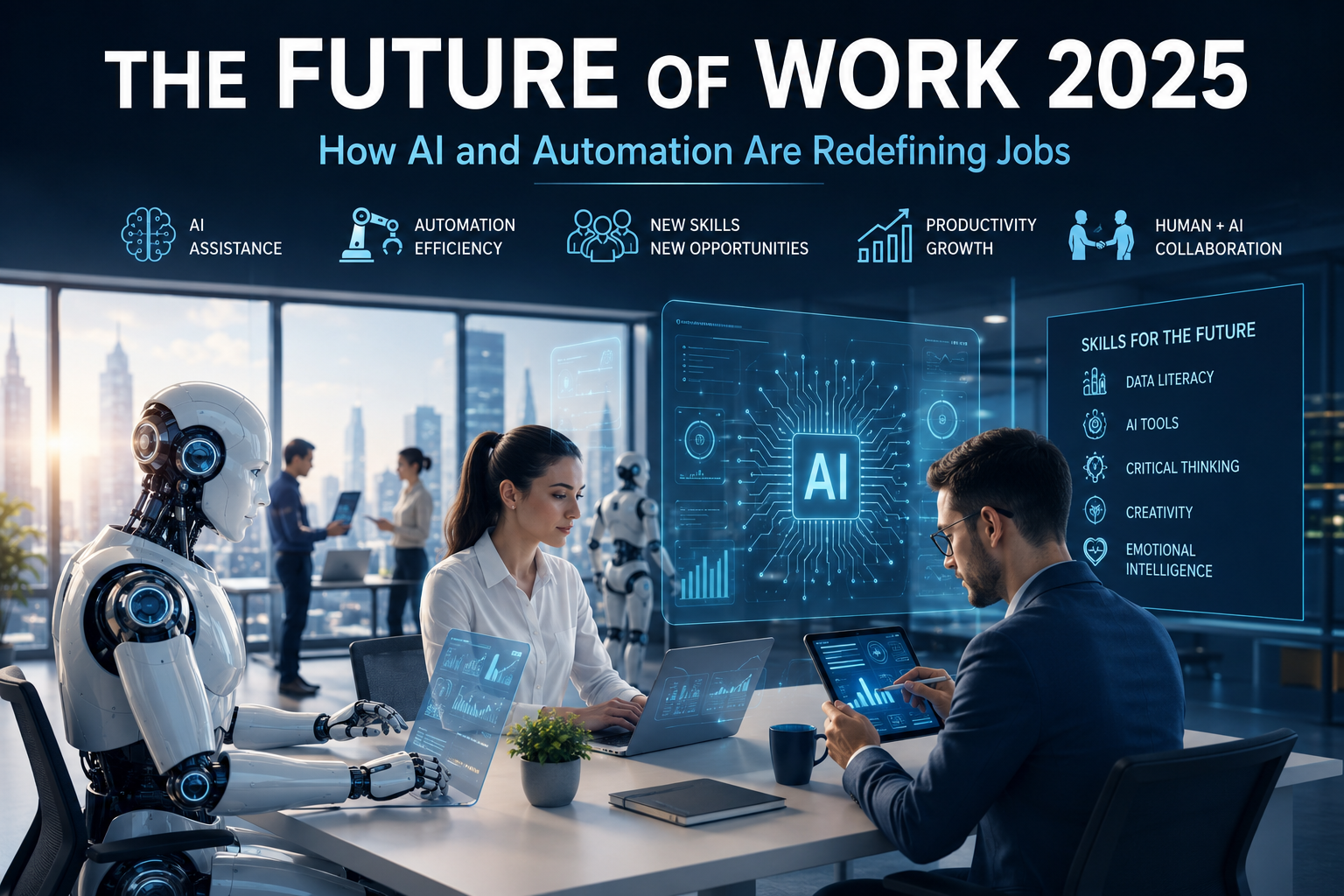
The future of work is changing fast in 2025. AI and automation now help people complete tasks, manage data, and improve work quality. These tools save time and support better decisions. As a result, many companies invest in smart technology.
Today, businesses want speed, accuracy, and better customer service. Therefore, AI systems play a bigger role in daily operations. Workers now use intelligent software, digital assistants, and automated tools across many industries.
The Future of Work: How AI and Automation Are Redefining Jobs in 2025 is one of the most important and transformative workplace trends of this decade. It shapes careers, business growth, and workforce development across the world.
Understanding AI and Automation
What Is Artificial Intelligence
Artificial intelligence refers to computer systems that perform tasks that often need human thinking. These tasks include learning, problem-solving, language understanding, and data analysis. Today, AI powers chatbots, recommendation systems, and virtual assistants.
Many businesses use AI to study large amounts of information. As a result, managers gain useful insights and make better decisions. AI also helps teams improve productivity and customer experiences.
What Is Automation
Automation uses technology to complete tasks with little human effort. It handles repetitive work such as data entry, scheduling, and inventory tracking. Therefore, employees spend more time on valuable tasks.
Many organizations combine automation with AI. This combination creates smarter systems that learn from data and improve performance. As a result, workplaces become more efficient and competitive.
Why Workplaces Are Changing in 2025
Growth of Smart Technology
Companies adopt smart tools because technology continues to improve. Cloud computing, machine learning, and advanced software make AI easier to use. Therefore, even small businesses can access powerful digital solutions.
Look, many organizations now rely on AI for customer support, marketing, and operations. This trend drives workplace transformation and increases demand for digital skills.
Demand for Faster Work
Customers expect quick service and accurate results. Therefore, businesses use automation to meet these expectations. Automated systems process information faster than manual methods.
Trust me, speed matters in today’s market. Companies that embrace technology often improve performance and maintain a stronger position against competitors.
Industries Seeing the Biggest Changes
Healthcare
Healthcare organizations use AI to analyze medical records and support diagnosis. Doctors receive useful insights that help treatment planning. As a result, patient care improves.
Manufacturing
Factories use robots and automated machines for production tasks. These systems reduce errors and increase output. Therefore, manufacturers improve efficiency and product quality.
Retail
Retail companies use AI to understand customer behavior and manage inventory. Smart systems predict demand and improve shopping experiences. As a result, stores increase sales and customer satisfaction.
Finance
Banks and financial institutions use AI to detect fraud and analyze transactions. These tools support risk management and improve security. Therefore, customers enjoy safer financial services.
Jobs That AI Supports
AI supports many jobs instead of replacing them. Professionals use AI tools to gather information, create reports, and manage projects. Therefore, workers complete tasks with greater efficiency.
Marketing specialists, teachers, healthcare workers, and customer service teams benefit from AI assistance. These tools help employees focus on creativity, communication, and strategy.
Jobs Supported by AI
| Job Role | AI Support Function |
| Teacher | Learning analytics |
| Doctor | Medical insights |
| Marketer | Customer analysis |
| Accountant | Data processing |
| Customer Agent | Chat assistance |
Jobs Facing Major Changes
Some roles involve repetitive tasks. Therefore, automation can handle many of these activities. Data entry, routine processing, and simple administrative work continue to evolve.
However, this change does not mean work disappears. Instead, employees often move toward higher-value responsibilities. New training programs help workers adapt to changing job requirements.
New Career Opportunities Created by AI
AI creates new career paths across industries. Companies need AI specialists, machine learning engineers, data analysts, and automation consultants. Therefore, demand for technology professionals continues to grow.
Bro, many businesses also hire cybersecurity experts and digital transformation managers. These positions support the safe and effective use of advanced technologies.
Skills Workers Need in 2025
Technical Skills
Workers benefit from digital literacy, data analysis, and software knowledge. These skills help employees use modern tools and adapt to workplace changes.
Learning basic AI concepts also provides an advantage. Therefore, many professionals join online courses and training programs.
Human Skills
Human skills remain valuable. Communication, teamwork, leadership, and creativity help people solve problems and build relationships.
You know, machines process data well. However, people bring empathy, judgment, and innovation. These strengths continue to matter in every industry.
Benefits of AI and Automation
AI and automation provide many advantages for businesses and workers. They improve productivity, reduce errors, and support faster decision-making. Therefore, organizations achieve better results.
These technologies also help companies save costs and improve customer experiences. As a result, businesses grow while maintaining high service standards.
Benefits of AI and Automation
| Benefit | Impact |
| Productivity | Faster task completion |
| Accuracy | Fewer mistakes |
| Cost Savings | Reduced operational costs |
| Customer Service | Better user experience |
| Data Insights | Stronger decisions |
Challenges for Employees
Workplace transformation also brings challenges. Some workers need new skills to remain competitive. Therefore, continuous learning becomes important.
Like many major changes, technology adoption requires adjustment. Employees who embrace learning often find new opportunities and career growth.
Steps to Prepare for the Future of Work
Step 1: Learn Digital Skills
Build knowledge in technology, software, and data tools. These skills improve employability and workplace value.
Step 2: Develop Human Strengths
Focus on communication, leadership, and problem-solving. These abilities remain essential across industries.
Step 3: Stay Updated
Follow technology trends and industry developments. Continuous learning supports long-term career success.
AI and Human Collaboration
The strongest workplaces combine human talent with intelligent technology. AI handles data-heavy tasks, while people focus on strategy and relationships. Therefore, organizations gain the best of both worlds.
This partnership improves productivity and innovation. As a result, businesses create better products, services, and customer experiences.
Future Job Market Trends
The job market continues to evolve as technology advances. Demand for digital skills, cybersecurity, and AI expertise grows each year. Therefore, education and training remain important.
Many organizations now invest in workforce development programs. These initiatives help employees prepare for changing workplace needs and future opportunities.
FAQ’s
What is the future of work in 2025?
The future of work focuses on AI, automation, digital transformation, and human-machine collaboration. Companies use smart tools to improve productivity and efficiency.
How does AI affect jobs?
AI supports many tasks, improves workflows, and creates new career opportunities. It also changes some traditional job roles.
Which industries use AI the most?
Healthcare, manufacturing, retail, finance, logistics, and customer service use AI extensively in daily operations.
What skills are important for future jobs?
Digital literacy, data analysis, communication, creativity, leadership, and problem-solving skills remain highly valuable.
Can humans and AI work together?
Yes. AI handles repetitive and data-driven tasks, while humans contribute creativity, judgment, and relationship-building skills. This collaboration improves workplace performance.
Conclusion
AI and automation continue to reshape the workplace in 2025. These technologies improve efficiency, support decision-making, and create new career opportunities. Therefore, businesses across industries adopt smart solutions.
Workers who develop technical and human skills position themselves for success. Continuous learning helps employees adapt to changing job requirements and workplace expectations.
The future of work combines human creativity with advanced technology. Together, people and AI create stronger organizations, better services, and sustainable growth for the years ahead.