
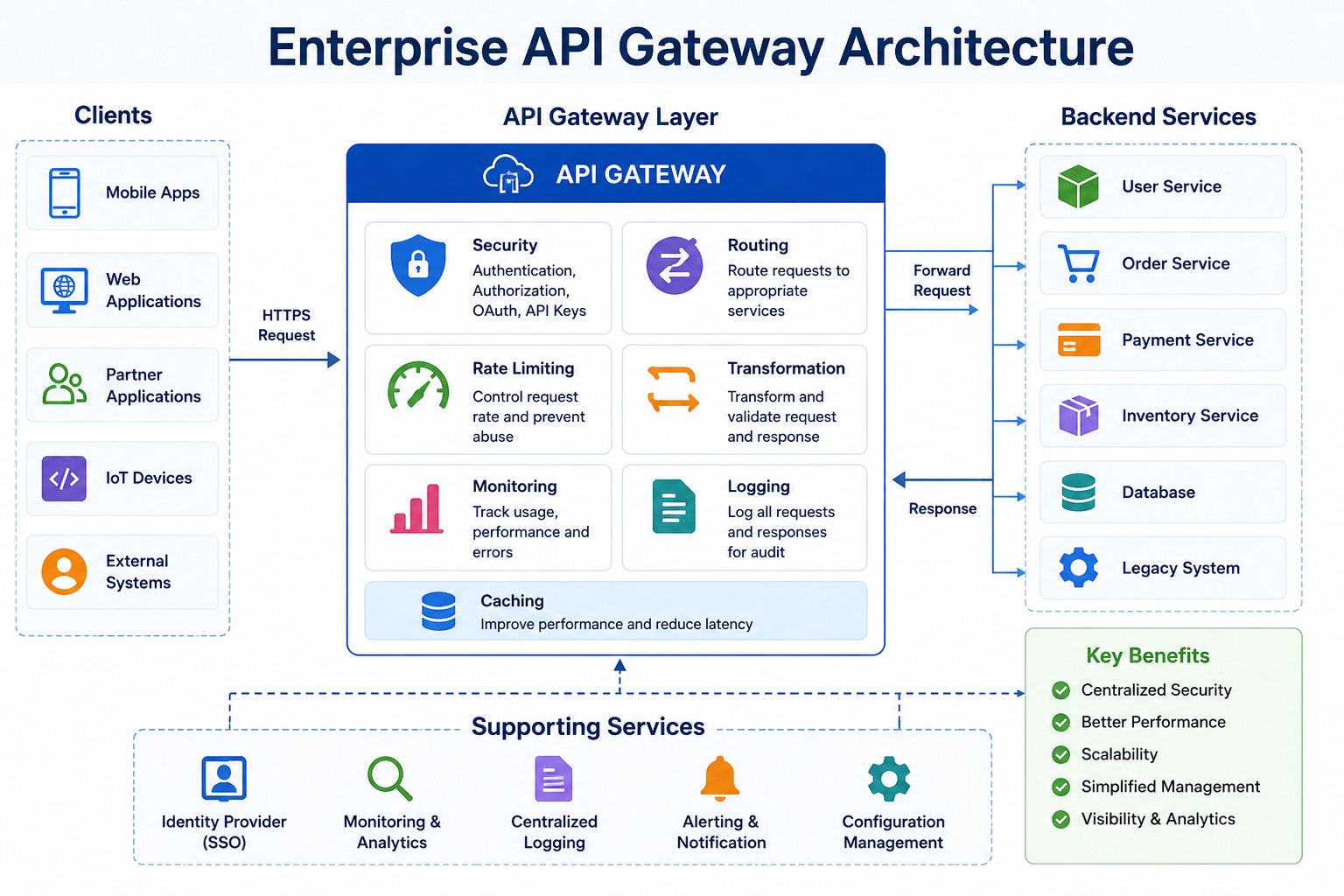
Enterprise API Gateway Architecture is a framework that helps companies manage, secure, and control API traffic across many systems. It acts like a central entry point between users, apps, and backend services. As a result, businesses can handle requests in a safe and organized way.
Today, many companies use cloud services, mobile apps, and microservices. Because of this, API management becomes important. An API gateway helps route requests, apply security rules, and improve performance. Therefore, it supports smooth communication between systems.
The Enterprise API Gateway Architecture is one of the most complete and powerful ways to manage APIs in large organizations. It helps teams improve security, scalability, and system control. In addition, it creates a better experience for users and developers.
Understanding API Gateways
What Is an API Gateway
An API gateway is a software layer that receives API requests and sends them to the correct backend service. It works as a single access point. As a result, clients do not need direct access to internal systems. The gateway handles tasks such as routing, authentication, and monitoring. Therefore, developers can focus on business functions instead of infrastructure tasks.
Why Enterprises Need API Gateways
Large organizations manage hundreds of APIs. Because of this, direct communication between clients and services becomes difficult. An API gateway simplifies management. In addition, it helps maintain security policies and traffic control across all services.
Core Components of Enterprise API Gateway Architecture
Request Routing
Request routing directs traffic to the correct service. As a result, users reach the right application function. Routing rules improve organization. Therefore, backend services remain easy to manage and maintain.
Authentication and Authorization
Authentication checks user identity. After that, authorization decides which resources a user can access. These controls protect sensitive business data. As a result, organizations reduce security risks.
Traffic Management
Traffic management controls request flow. Therefore, systems avoid overload during peak usage. Rate limiting and throttling help balance traffic. In addition, they improve service stability.
Monitoring and Analytics
Monitoring tracks API performance and usage. As a result, teams can identify issues quickly. Analytics also provide insights into user behavior. Therefore, businesses can improve services and planning.
Key Features of Enterprise API Gateway Architecture
Centralized Security
Centralized security places protection rules in one location. Because of this, security becomes easier to manage. Look, companies can apply policies across many APIs without repeating work. As a result, consistency improves.
Load Balancing
Load balancing spreads traffic across multiple servers. Therefore, no single server receives too many requests. Trust me, this feature helps maintain service availability during high demand periods.
API Transformation
API transformation converts data formats between systems. As a result, different applications can communicate without problems. This feature supports integration projects. Therefore, businesses connect old and new systems with ease.
Architecture Layers in an Enterprise API Gateway
Client Layer
The client layer includes mobile apps, web applications, and external systems. These clients send requests to the gateway. As a result, backend services remain hidden from direct access.
Gateway Layer
The gateway layer processes requests. It applies security checks, routing rules, and traffic controls. Therefore, all communication passes through a managed environment.
Service Layer
The service layer contains microservices and backend applications. These systems handle business logic and data processing. As a result, organizations can scale services independently.
Benefits of Enterprise API Gateway Architecture
Better Security
Security remains a top priority for enterprises. Therefore, API gateways provide strong access controls and policy enforcement. As a result, organizations protect critical systems and customer information.
Improved Scalability
Businesses grow over time. Because of this, systems need flexible scaling options. API gateways support traffic growth. Therefore, services continue to perform well during expansion.
Simplified Management
A single gateway manages many APIs. As a result, administration becomes easier. Bro, teams save time because they manage policies from one location instead of many places.
Enterprise API Gateway Deployment Models
On-Premises Deployment
On-premises gateways run inside company data centers. Therefore, organizations maintain full infrastructure control. This model suits businesses with strict compliance requirements.
Cloud-Based Deployment
Cloud gateways operate on cloud platforms. As a result, deployment becomes faster and more flexible. Many companies choose cloud models because they support rapid growth.
Hybrid Deployment
Hybrid deployments combine cloud and on-premises systems. Therefore, organizations gain flexibility and control. This approach supports modern digital transformation projects.
Enterprise API Gateway Functions
| Function | Purpose |
| Routing | Directs requests to services |
| Authentication | Verifies user identity |
| Authorization | Controls access rights |
| Rate Limiting | Prevents excessive traffic |
| Monitoring | Tracks API performance |
| Logging | Records system activities |
Benefits Comparison Table
| Benefit | Business Impact |
| Security | Protects data and services |
| Scalability | Supports business growth |
| Reliability | Reduces downtime |
| Visibility | Improves monitoring |
| Integration | Connects different systems |
| Governance | Enforces API policies |
Best Practices for Enterprise API Gateway Architecture
Implement Strong Security Policies
Organizations should use token-based authentication and encryption. As a result, sensitive information remains protected. Security reviews should occur on a regular schedule. Therefore, risks stay under control.
Monitor API Performance
Performance monitoring helps identify bottlenecks. As a result, teams solve issues before users notice them. Like many successful enterprises, companies should track response times and error rates.
Use Rate Limiting
Rate limiting controls excessive requests. Therefore, services remain available for all users. This practice also protects systems from misuse and traffic spikes.
Role in Microservices Environments
Microservices create many independent services. Because of this, managing communication becomes complex. An API gateway acts as a central control point. Therefore, developers gain better visibility and management. You know, many modern enterprises rely on API gateways to support microservice architectures and cloud-native applications.
Future Trends in API Gateway Architecture
Artificial intelligence supports traffic analysis and threat detection. As a result, API management becomes smarter. Zero-trust security models continue to grow. Therefore, gateways apply stricter access controls. Cloud-native technologies also shape future architectures. As a result, enterprises gain better flexibility and performance.
FAQ’s
What is Enterprise API Gateway Architecture?
Enterprise API Gateway Architecture is a framework that manages, secures, and routes API traffic through a central gateway for business applications and services.
Why is an API gateway important for enterprises?
It improves security, scalability, monitoring, and API management. As a result, organizations can operate complex systems more efficiently.
How does an API gateway improve security?
It provides authentication, authorization, encryption, and traffic control. Therefore, unauthorized access becomes harder.
Can API gateways support microservices?
Yes. API gateways help manage communication between clients and multiple microservices through a single access point.
What are common deployment models for API gateways?
The most common models are on-premises, cloud-based, and hybrid deployments. Each option supports different business needs and infrastructure strategies.
Conclusion
Enterprise API Gateway Architecture plays a key role in modern digital systems. It provides a central location for security, routing, monitoring, and traffic management. Therefore, organizations gain better control over their APIs.
Businesses use API gateways to improve scalability, reliability, and system performance. As a result, they support growing user demands while maintaining security standards. This approach also simplifies management across large environments.
As technology continues to evolve, API gateways remain an important part of enterprise architecture. Therefore, companies that invest in strong API gateway strategies can build secure, flexible, and future-ready digital platforms.