
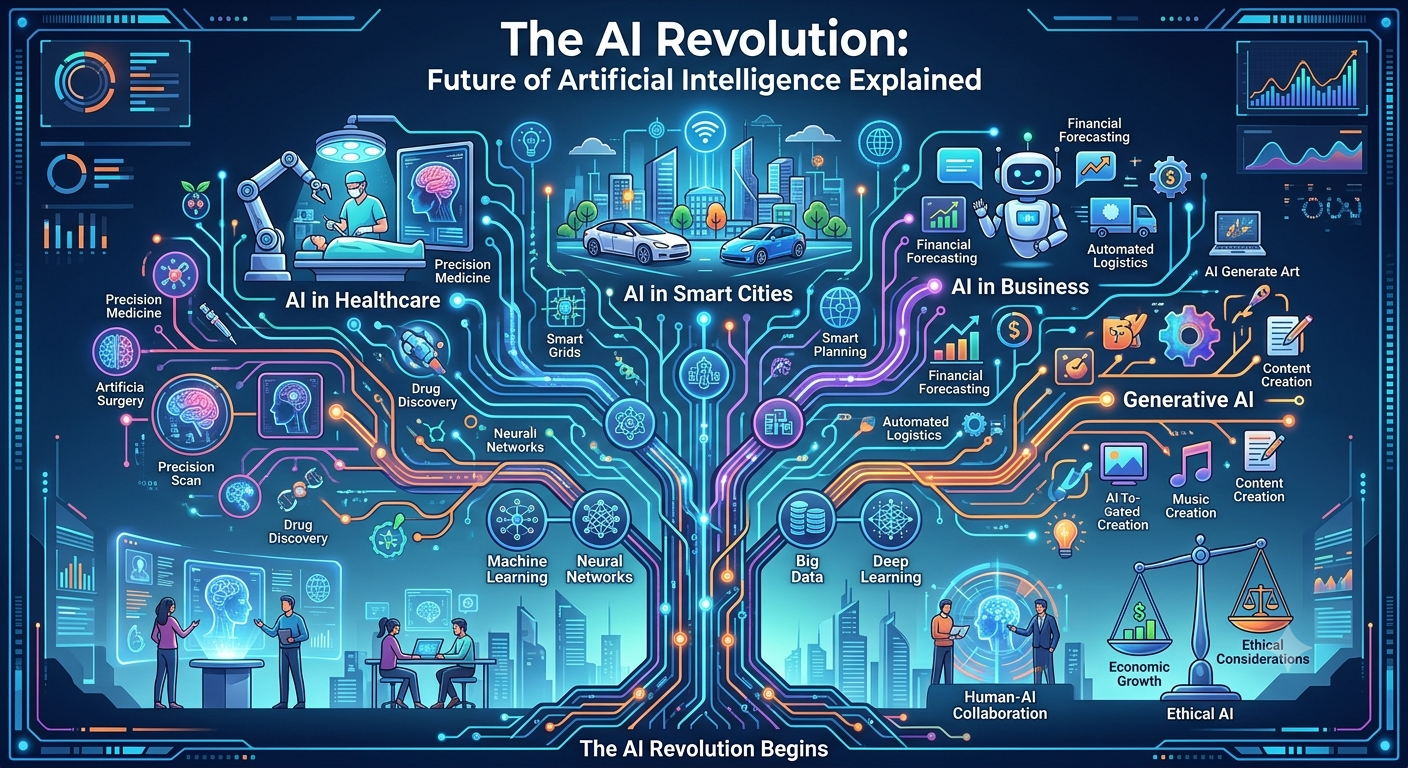
The AI Revolution is a major change in the way people use technology. Artificial intelligence, or AI, helps machines learn, think, and solve tasks. Today, AI supports work, education, health care, and business. As a result, many industries use smart systems to improve results.
AI uses data and computer programs to find patterns. Then it makes choices based on that information. Because of this, people complete many tasks in less time. The AI Revolution stands as the greatest technology shift of the modern age. It shapes daily life and creates new opportunities across the world.
Understanding Artificial Intelligence
Artificial intelligence is a branch of computer science. It focuses on creating systems that perform tasks that need human thinking. For example, AI can recognize speech, understand text, and analyze data. Therefore, many companies invest in AI technology.
AI learns from information. It studies large amounts of data and finds useful patterns. Then it uses those patterns to make decisions. As a result, AI tools become more accurate over time. This process supports better performance in many fields.
Core Parts of AI
- Machine Learning
- Deep Learning
- Natural Language Processing
- Computer Vision
- Predictive Analytics
The History of AI Development
The idea of AI started many years ago. Early researchers wanted computers to solve problems like humans. During the 1950s, scientists built the first AI programs. These systems handled simple tasks and calculations.
Over time, computer power increased. At the same time, more data became available. Because of these changes, AI systems improved. Today, advanced AI models can create content, analyze images, and support decision-making in many industries.
Important AI Milestones
| Year | Milestone |
| 1956 | AI research field begins |
| 1997 | Computer defeats chess champion |
| 2011 | AI wins quiz competition |
| 2022+ | Generative AI grows rapidly |
Machine Learning and AI Growth
Machine learning drives modern AI systems. It allows computers to learn from data without direct instructions. Therefore, businesses use machine learning to improve services and products.
Machine learning models study patterns. Then they predict future outcomes. For example, online stores recommend products based on customer behavior. As a result, users receive more relevant suggestions and better experiences.
Machine Learning Benefits
- Better predictions
- Faster analysis
- Improved efficiency
- Data-driven decisions
- Cost savings
AI in Everyday Life
AI appears in many daily activities. People use it when they search online, watch videos, or use mobile apps. Because of AI, many services work faster and provide useful recommendations. Smart assistants also rely on AI. They help users manage schedules, answer questions, and perform tasks. As a result, people save time and complete activities with less effort.
AI in Education
Education continues to benefit from AI technology. Schools and learning platforms use AI tools to support students. These tools create learning paths based on student needs. Teachers also gain support from AI systems. They can review performance data and identify learning gaps. Therefore, educators provide better guidance and improve student outcomes.
Educational Advantages
| Feature | Benefit |
| Personalized Learning | Matches student needs |
| Smart Assessment | Tracks progress |
| Learning Analytics | Finds weak areas |
| Digital Tutors | Provides support |
AI in Healthcare
Healthcare organizations use AI to improve patient care. AI systems analyze medical data and support diagnosis. Therefore, doctors gain valuable insights during treatment. AI also helps hospitals manage resources. It organizes information and supports planning. As a result, healthcare teams work more efficiently and improve patient experiences.
AI in Business Operations
Businesses use AI to improve productivity. AI tools automate routine tasks and process information quickly. Because of this, employees focus on strategic work. Companies also use AI for customer service. Chatbots answer common questions and provide support. Therefore, businesses serve customers faster and improve satisfaction levels.
AI and Automation
Automation and AI work together. Automation handles repetitive tasks, while AI adds decision-making abilities. As a result, organizations improve efficiency and reduce manual effort.
Many industries use AI-powered automation. Manufacturing, logistics, and finance rely on these systems. Therefore, operations become faster and more consistent.
Steps in AI Automation
Step 1: Collect Data
Gather useful information from different sources.
Step 2: Train Models
Use data to teach AI systems.
Step 3: Test Performance
Check results and accuracy.
Step 4: Deploy Solutions
Use AI tools in real environments.
Step 5: Improve Continuously
Update systems with new information.
AI in Customer Experience
Customer experience improves through AI technology. Businesses analyze customer behavior and preferences. Then they create personalized interactions. AI chat systems provide quick answers. At the same time, recommendation engines suggest useful products. Therefore, customers receive relevant support and better service.
AI and Big Data
Big data plays a key role in AI success. AI systems need information to learn and improve. Therefore, organizations collect and analyze large datasets. AI finds patterns that humans may miss. As a result, businesses gain insights that support growth and innovation. This connection between AI and big data continues to shape modern technology.
AI in Cybersecurity
Cybersecurity teams use AI to detect threats. AI systems analyze network activity and identify unusual behavior. Therefore, organizations respond to risks more quickly. AI also strengthens digital protection. It monitors systems and supports threat prevention. As a result, businesses reduce security risks and improve safety.
Challenges of AI Adoption
AI offers many benefits. However, organizations face challenges during implementation. Data quality, training costs, and technical skills often require attention. Companies also focus on responsible AI practices. They work to improve transparency and fairness. Therefore, careful planning remains important for successful AI adoption.
Future Trends in AI
The future of AI shows strong potential. New technologies continue to improve machine intelligence. Therefore, AI applications will expand across industries. Generative AI, robotics, and smart analytics continue to grow. As a result, organizations discover new ways to solve problems and create value. The future promises more innovation and transformation.
Economic Impact of AI
AI contributes to economic growth. Businesses improve efficiency and create new products. Therefore, many industries increase productivity through AI adoption. AI also creates demand for new skills. Workers learn data analysis, machine learning, and digital technologies. As a result, the workforce continues to evolve.
Responsible AI Development
Responsible AI focuses on fairness, transparency, and trust. Organizations develop policies that guide AI use. Therefore, users gain confidence in AI systems. Companies also review outcomes and reduce risks. This approach supports ethical technology growth. As a result, AI continues to deliver value while respecting human needs.
FAQ’s
What is the AI Revolution?
The AI Revolution refers to the rapid growth and adoption of artificial intelligence technologies across industries and daily life. It changes how people work, learn, and solve problems.
How does AI learn?
AI learns through data. Machine learning algorithms analyze information, identify patterns, and improve performance based on experience.
Where is AI used today?
AI is used in healthcare, education, finance, cybersecurity, retail, manufacturing, transportation, and customer service.
What are the benefits of AI?
AI improves productivity, supports decision-making, reduces repetitive work, enhances customer experiences, and increases efficiency.
What is the future of AI?
The future includes smarter automation, advanced robotics, better predictive analytics, improved healthcare solutions, and wider business adoption.
Conclusion
The AI Revolution continues to transform technology and society. AI supports education, healthcare, business, cybersecurity, and automation. Therefore, organizations use AI to improve efficiency and create better outcomes.
Machine learning, big data, and intelligent systems drive this progress. At the same time, responsible development remains important. Because of this balance, AI can support innovation while maintaining trust and reliability.
The future of AI holds great promise. New tools and applications continue to emerge across industries. As a result, the AI Revolution will remain a key force in shaping the digital world for many years.