
Cloud deployment means placing apps, data, and services on cloud servers. These servers run on the internet. Companies use cloud platforms to store files, run software, and manage workloads. This method helps teams access resources from many locations.
Today, cloud technology supports businesses of all sizes. Small startups and large enterprises use cloud environments for daily operations. Look, cloud systems reduce hardware needs and improve access to digital tools. As a result, many organizations move workloads from local servers to cloud platforms.
Why Cloud Deployment Matters
Modern businesses need speed and flexibility. Therefore, cloud deployment helps teams launch services without buying large amounts of hardware. This approach saves time and supports growth. You know, customers expect fast online experiences. Cloud infrastructure supports this goal through scalable resources and reliable systems. Trust me, companies that use cloud solutions often respond to market changes with greater efficiency.
Understanding Cloud Computing
Cloud computing provides computing resources through the internet. These resources include storage, networking, databases, and processing power. Users access them when needed. Instead of owning physical servers, businesses rent cloud resources. This model lowers upfront costs and simplifies management. As a result, teams focus more on products and services rather than hardware maintenance.
Main Components of Cloud Deployment
Several parts work together in a cloud environment. Servers provide computing power. Storage systems keep files and data safe. Networks connect resources and users. Management tools help teams control workloads. Security systems protect data and applications. Together, these components create a complete cloud ecosystem that supports business operations.
Types of Cloud Deployment Models
Public Cloud
A public cloud offers services through shared infrastructure. Cloud providers manage the hardware and platform. Therefore, businesses gain access to resources without managing physical equipment. Public cloud environments suit startups and growing businesses. They provide flexibility and cost savings. Many organizations choose this model for web applications and online services.
Private Cloud
A private cloud serves one organization. Resources stay dedicated to that business. As a result, companies gain greater control over data and security. Many industries use private clouds for sensitive information. Healthcare, finance, and government sectors often prefer this model because of compliance requirements.
Hybrid Cloud
A hybrid cloud combines public and private cloud environments. Businesses place some workloads in private systems and others in public platforms. This model offers flexibility and balance. Companies keep critical data secure while using public resources for growth and demand spikes.
Multi-Cloud
A multi-cloud strategy uses services from several cloud providers. Organizations avoid dependence on one vendor. Therefore, they gain more flexibility and resilience. Large enterprises often use this model. It helps improve performance and supports business continuity across different platforms.
Cloud Deployment Models Comparison
| Model | Cost | Control | Scalability | Security |
| Public Cloud | Low | Medium | High | Medium |
| Private Cloud | High | High | Medium | High |
| Hybrid Cloud | Medium | High | High | High |
| Multi-Cloud | Medium | Medium | High | High |
Benefits of Cloud Deployment
Cloud deployment provides many advantages. First, businesses scale resources based on demand. Second, teams access systems from different locations. Moreover, cloud platforms support disaster recovery and data backup. The most powerful Cloud Deployment 101 approach helps organizations improve flexibility, efficiency, and business growth. These benefits make cloud technology a key part of digital transformation.
Common Cloud Services
Cloud providers offer different service models. Infrastructure as a Service provides servers, networking, and storage. Platform as a Service offers tools for application development. Software as a Service delivers ready-to-use applications through browsers. Therefore, businesses select services that match their goals and technical requirements.
Cloud Deployment Process
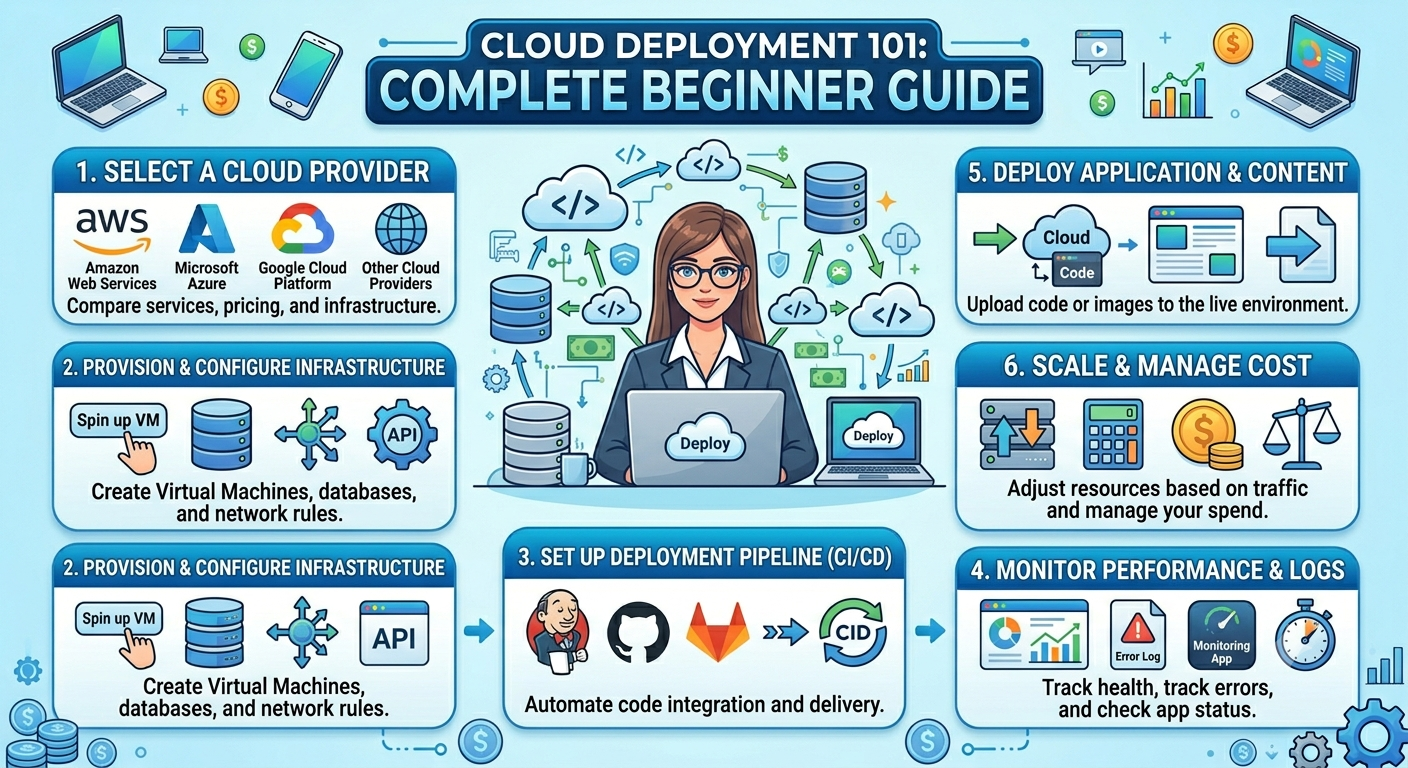
Step 1: Plan Requirements
Organizations define business goals and technical needs. Teams identify workloads, applications, and expected growth.
Step 2: Choose a Cloud Provider
Next, companies compare providers based on pricing, performance, and security features. This step supports long-term success.
Step 3: Configure Resources
Teams create storage, networks, databases, and computing environments. Proper setup improves performance and reliability.
Step 4: Deploy Applications
After setup, applications move to cloud infrastructure. Testing confirms that systems operate correctly.
Step 5: Monitor Performance
Continuous monitoring helps detect issues early. Therefore, businesses maintain stable and efficient operations.
Security in Cloud Deployment
Security remains a major priority in cloud environments. Strong passwords protect user accounts. Access controls limit resource usage. In addition, encryption protects data during storage and transfer. Regular updates strengthen system protection. These practices reduce risks and support compliance requirements.
Cost Management Strategies
Cloud spending requires careful planning. Organizations track resource usage and remove unused services. This approach prevents waste. Furthermore, businesses use automation and scaling tools to control expenses. Budget monitoring helps maintain financial efficiency while supporting operational goals.
Best Cost Optimization Methods
| Strategy | Benefit |
| Resource Monitoring | Reduces waste |
| Auto Scaling | Matches demand |
| Reserved Instances | Lowers long-term cost |
| Storage Optimization | Saves space |
| Usage Reports | Improves visibility |
Common Challenges
Cloud deployment brings challenges along with benefits. Data migration can require planning and testing. Complex systems may create management difficulties. Vendor dependence also affects some organizations. Therefore, businesses need strong strategies to reduce risks and maintain flexibility across platforms.
Best Practices for Success
Successful cloud projects start with clear planning. Teams should define objectives before deployment. Good documentation supports smooth operations. Regular security reviews improve protection. Employee training strengthens cloud skills. As a result, organizations gain better performance and long-term value.
Future of Cloud Deployment
Cloud technology continues to evolve. Artificial intelligence, automation, and edge computing shape future cloud environments. These innovations improve efficiency and speed. Businesses will continue adopting cloud solutions to support digital growth. Therefore, cloud deployment remains a core part of modern technology strategies.
FAQ’s
What is cloud deployment?
Cloud deployment is the process of placing applications, services, and data on cloud infrastructure so users can access them through the internet.
Which cloud deployment model is most common?
Public cloud remains one of the most common models because it offers scalability, flexibility, and lower costs.
Why do companies use cloud deployment?
Companies use cloud deployment to improve efficiency, reduce hardware costs, and support business growth.
Is cloud deployment secure?
Cloud deployment can provide strong security when organizations use encryption, access controls, and regular security reviews.
What are the main cloud service models?
The main service models include Infrastructure as a Service, Platform as a Service, and Software as a Service.
Conclusion
Cloud deployment helps organizations run applications and services through internet-based infrastructure. It supports flexibility, scalability, and efficient resource management. As a result, businesses improve operational performance.
Many deployment models serve different needs. Public, private, hybrid, and multi-cloud environments each offer unique advantages. Therefore, organizations choose models based on goals and security requirements.
The future of cloud technology looks strong. Artificial intelligence, automation, and advanced infrastructure continue to improve cloud capabilities. Businesses that adopt cloud strategies position themselves for long-term success.