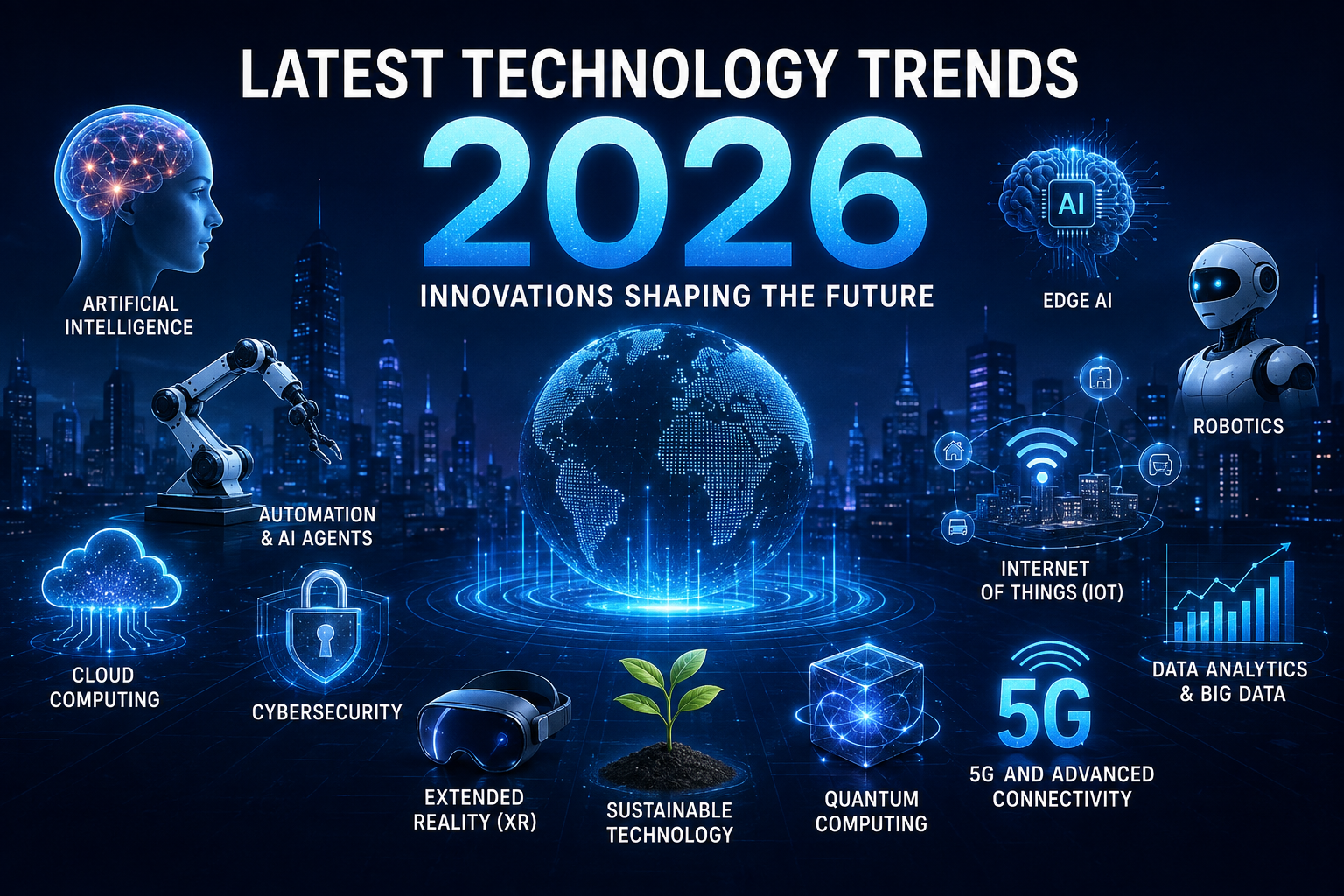
Technology keeps moving at a fast pace. Every year brings new tools, ideas, and systems that change how people work and live. In 2026, this change is even more visible. Artificial intelligence, automation, cloud computing, cybersecurity, robotics, and smart devices are becoming part of daily life.
Businesses are also using new technology to save time and improve their services. At the same time, users want tools that are faster, safer, and easier to use. Therefore, understanding the latest technology trends 2026 can help businesses, students, developers, and everyday users make better choices.
This guide covers the major technology trends that are shaping 2026. It also explains how these trends work, where they are useful, and what they may mean for the future.
Artificial Intelligence Is Becoming More Practical
Artificial intelligence remains one of the biggest technology trends in 2026. However, the focus is changing. AI is no longer used only for simple chat or basic content tasks. Instead, companies are building AI into software, customer support, search, analytics, coding, and business systems.
Modern AI tools can understand text, images, audio, and other forms of information. As a result, users can work with technology in more natural ways. AI can also help people summarize documents, analyze data, write code, create plans, and find useful information.
Another major shift is the growth of AI agents. These systems can handle a series of tasks instead of giving only one response. For example, an AI agent may collect information, organize it, create a report, and send the result through a connected system.
AI Agents and Intelligent Automation
AI agents are becoming an important part of business automation. Traditional automation follows fixed rules. For example, a system may move data from one field to another when a specific condition is met.
AI agents can work with more flexible instructions. They can interpret information, make choices within defined limits, and use different software tools. Therefore, they can support more complex workflows.
For example, a business could use an AI agent to review customer requests. The agent could classify each request, find related account information, prepare a response, and send difficult cases to a human worker.
| Traditional Automation | AI Agent Automation |
|---|---|
| Follows fixed rules | Handles flexible instructions |
| Works well with predictable tasks | Can handle more complex workflows |
| Limited decision-making | Can make decisions within set limits |
| Usually uses predefined paths | Can choose from connected tools |
| Easier to predict | Requires stronger monitoring |
AI agents still need controls. Human review, access limits, logging, and security rules remain important.
Edge AI Is Bringing Intelligence Closer to Devices
Cloud computing has made AI services easier to access. Yet sending every piece of data to a remote server can create delays and privacy concerns. This is why edge AI is gaining attention. Edge AI means running AI models closer to where data is created. The processing may happen on a phone, camera, vehicle, industrial machine, or other device.
This approach can reduce the need to send all data to a cloud server. It can also improve response time. For example, a smart camera may detect an object on the device instead of sending every video frame to a remote system.
Edge AI is useful in areas such as:
- Smart cameras
- Industrial machines
- Mobile devices
- Connected vehicles
- Healthcare equipment
- Smart home systems
- Robotics
As hardware becomes more capable, more AI processing can happen locally.
Cloud Computing Is Becoming More Flexible
Cloud computing remains a core part of modern technology. Businesses use cloud platforms for storage, applications, databases, analytics, and computing power. In 2026, companies are also looking for more flexible cloud strategies. Many organizations use a mix of public cloud, private infrastructure, and edge computing. This approach is often called hybrid computing.
Cloud-native development is also important. Developers can build applications using containers, APIs, micro services, and managed services. These methods can help teams deploy software faster and scale systems when demand changes. The goal is not simply to move everything to the cloud. Instead, companies are choosing the right environment for each workload.
Cybersecurity Is Becoming More Important
As technology grows, security risks also grow. Businesses now depend on cloud systems, APIs, mobile devices, remote access, and connected software. Cyber security has become a basic business need. One major focus is identity security. Companies are using stronger authentication methods and access controls to make sure that users and systems have the right permissions.
Zero-trust security is also gaining importance. The basic idea is simple: users and devices should not receive automatic trust just because they are inside a network. Security teams are also using AI to detect unusual activity. AI can help process large amounts of security data and identify patterns that may deserve attention.
| Cybersecurity Area | Main Goal |
|---|---|
| Identity security | Protect user accounts |
| Zero trust | Limit unnecessary trust |
| Endpoint security | Protect devices |
| Cloud security | Protect cloud resources |
| API security | Protect software connections |
| Threat detection | Find suspicious activity |
| Data protection | Protect sensitive information |
Strong security requires more than one tool. It needs good policies, secure software, employee training, monitoring, and regular testing.
Robotics Is Moving Beyond Factories
Robotics has long been used in manufacturing. However, robots are now appearing in more environments. Modern robots can use sensors, computer vision, AI models, and advanced control systems. These technologies allow robots to interact with changing environments more effectively.
Companies are exploring robots for warehouses, logistics, agriculture, healthcare, inspection, and delivery. Humanoid robots are also receiving significant attention, although their practical use is still developing. Robotics can help with repetitive or physically demanding work. Yet human workers remain important for planning, judgment, maintenance, and tasks that require social understanding.
The future is likely to involve humans and robots working together rather than robots replacing every human task.
AI-Powered Software Development
Software development is another area being changed by AI. Developers can now use AI coding assistants to generate code, explain functions, identify bugs, create tests, and work with documentation. This does not remove the need for programming knowledge. Instead, it can reduce time spent on repetitive coding work.
Developers still need to review generated code. They must also test applications and check security. AI can produce incorrect or unsafe code, especially when the instructions or project context are unclear. The best approach is to treat AI as a development assistant rather than an automatic replacement for engineering judgement.
The Growth of Privacy-Focused Technology
People are becoming more aware of how their data is collected and used. As a result, privacy is becoming an important part of technology design. Companies are exploring methods that reduce unnecessary data collection. Local processing can help in some cases because information does not always need to leave the user’s device.
Privacy-focused design can also include stronger access controls, encryption, data minimization, and clearer user permissions. This trend matters because trust can affect how people adopt new technology. A useful product may still fail to gain users if people do not feel that their data is handled responsibly.
Digital Twins Are Improving Real-World Systems
A digital twin is a digital representation of a physical object, system, or process. It can use data from sensors and other sources to represent what is happening in the real world. For example, a factory can create a digital model of a machine. Data from the real machine can then help the digital system show its condition.
Digital twins can support monitoring, testing, maintenance, and planning. They can also help companies identify possible problems before they become expensive failures. This technology is especially useful in manufacturing, construction, energy, transportation, and large infrastructure projects.
The Internet of Things Is Getting Smarter
The Internet of Things, or IoT, connects physical devices to networks. These devices can collect and share data. In 2026, IoT is becoming more intelligent because AI can process the data collected by connected devices.
For example, a smart building can use sensors to monitor temperature, energy use, lighting, and occupancy. AI can then help optimize these systems. Smart factories can use connected machines to track production. Smart agriculture can use sensors to monitor soil and environmental conditions.
The combination of IoT, AI, and edge computing can create faster and more responsive systems.
5G and Advanced Connectivity
Fast and reliable connectivity supports many modern technologies. 5G continues to provide a foundation for connected devices, smart systems, industrial applications, and mobile services. Better connectivity can help devices exchange information with lower delays. This is useful for applications that need fast communication.
Connectivity alone does not solve every problem. Businesses still need suitable hardware, software, security, and network design. As connectivity improves, more devices can work together as part of larger digital systems.
Extended Reality Is Finding Practical Uses
Extended reality includes virtual reality, augmented reality, and mixed reality. These technologies create or add digital elements to real or virtual environments. Entertainment remains an important use case. However, businesses are also exploring practical applications.
For example, companies can use virtual reality for training. Workers can practice procedures in a simulated environment before performing them in real situations. Augmented reality can also help technicians. Digital instructions can appear alongside physical equipment, which may reduce the need to switch between manuals and the work area.
Sustainable Technology Is Growing
Technology can create environmental costs because data centers, devices, networks, and manufacturing processes require energy and resources. Therefore, sustainable technology is becoming more important. Companies are looking for ways to improve energy efficiency and reduce waste.
Data centres are exploring efficient cooling and computing methods. Hardware companies are working on better energy use and material management. Software efficiency also matters. More efficient applications can reduce the computing resources required to perform tasks.
Sustainability is not just an environmental issue. It can also reduce operating costs and improve long-term business efficiency.
Quantum Computing Continues to Develop
Quantum computing is still an emerging field. It does not replace normal computers for everyday tasks. Instead, it uses quantum principles to approach certain problems in different ways. Researchers and companies continue to explore potential uses in areas such as optimization, materials science, chemistry, and cryptography.
Practical quantum computing still faces major technical challenges. Quantum systems can be difficult to build, control, and scale. Therefore, quantum computing should be viewed as a developing technology rather than a solution that is ready for every business today.
Advanced Data Analytics Is Driving Better Decisions
Data remains one of the most valuable resources for modern businesses. However, collecting data is not enough. Companies need systems that can turn data into useful information. AI and advanced analytics can help businesses identify trends, detect unusual patterns, forecast demand, and improve operations.
For example, an online store can analyze customer behavior to understand which products perform well. A logistics company can use data to improve routes and delivery planning. As data systems become more advanced, businesses that use reliable information effectively can make better decisions.
How Businesses Can Prepare for Technology Trends in 2026
Businesses do not need to adopt every new technology. Instead, they should focus on technologies that solve real problems.
A simple approach is to start with business goals. A company may want to reduce support costs, improve security, speed up software development, or provide better customer service.
Next, the company can identify technology that supports that goal. Small pilot projects can help teams test an idea before making a large investment.
| Step | Action |
|---|---|
| 1 | Identify a real business problem |
| 2 | Research suitable technology |
| 3 | Start with a small project |
| 4 | Measure the results |
| 5 | Review security and costs |
| 6 | Improve the solution |
| 7 | Scale when the results are clear |
This approach reduces waste and gives teams time to learn.
Skills People Should Learn in 2026
Technology changes quickly, so learning should focus on useful skills rather than one specific tool.
AI literacy is becoming valuable across many careers. People should understand how AI works at a basic level and learn how to use AI tools responsibly.
Other useful skills include:
- Cloud computing
- Cybersecurity
- Data analysis
- Python programming
- Automation
- API development
- Prompt design
- AI system evaluation
- Digital project management
- Technical problem solving
Soft skills also remain important. Communication, creativity, critical thinking, and teamwork are difficult to replace and help people work effectively with technology.
What These Technology Trends Mean for the Future
The biggest change is not one individual technology. Instead, different technologies are starting to work together.
AI can process information. Cloud systems can provide computing resources. Edge devices can process data closer to users. IoT devices can collect information. Automation can connect these systems and complete tasks.
This combination can create powerful digital systems.
However, technology also creates challenges. Businesses must consider security, privacy, cost, reliability, ethics, and workforce training.
The organizations that succeed will likely be those that adopt technology with a clear purpose. Using a new tool simply because it is popular does not guarantee success.
FAQ’s
What are the biggest technology trends in 2026?
Artificial intelligence, AI agents, automation, cloud computing, cybersecurity, robotics, edge AI, IoT, advanced analytics, and sustainable technology are among the major trends shaping 2026.
Is AI the most important technology trend in 2026?
AI is one of the most important trends because it is being integrated into many other technologies. However, cloud computing, cybersecurity, robotics, connectivity, and data systems also play major roles.
Will AI replace software developers?
AI can automate parts of software development, but developers are still needed for architecture, testing, security, system design, and complex problem solving. AI is more useful as an assistant than as a complete replacement.
Should small businesses adopt new technology?
Small businesses should adopt technology when it solves a real problem or creates measurable value. Starting with a small project is often safer than making a large investment immediately.
What technology skills should beginners learn in 2026?
Beginners can start with AI literacy, basic programming, cybersecurity, cloud computing, data analysis, and automation. These skills can provide a strong foundation for future learning.
Conclusion
The latest technology trends 2026 show a clear move toward smarter, more connected, and more automated systems. AI is becoming part of everyday software, while AI agents are helping automate more complex workflows. At the same time, cloud computing, edge AI, IoT, robotics, and advanced analytics are working together to create new solutions.
However, technology should not be adopted just because it is new. Businesses and individuals should focus on tools that provide real value. Security, privacy, cost, and reliability should remain part of every technology decision.
Finally, the future will belong to people and organizations that can learn and adapt. Technology will continue to change, but strong digital skills, critical thinking, and responsible use will remain useful. By understanding these trends early, businesses and professionals can prepare for the opportunities that 2026 and the years ahead may bring.